
Sam Young Sam Young
0 Course Enrolled • 0 Course CompletedBiography
Best Preparation Material For The CIPS L6M2 Exam Dumps from TestkingPass
As you know, your company will introduce new talent each year. In the face of their excellent resume, you must improve your strength to keep your position! Our L6M2 study questions may be able to give you some help. What you need may be an internationally-recognized L6M2 certificate, perhaps using the time available to complete more tasks. With our L6M2 study materials, you will pass the exam in the shortest possible time.
CIPS L6M2 Exam Syllabus Topics:
| Topic | Details |
|---|---|
| Topic 1 |
|
| Topic 2 |
|
| Topic 3 |
|
| Topic 4 |
|
2025 Updated L6M2 Valid Real Exam | 100% Free Valid Global Commercial Strategy Exam Guide
The pass rate is 98% for L6M2 exam bootcamp, if you choose us, we can ensure you that you can pass the exam just one time. In addition, we offer you free demo to have a try before buying, so that you can know what the complete version is like. In order to strengthen your confidence for L6M2 training materials, we are pass guarantee and money back guarantee, and we will refund your money if you fail to pass the exam. We have a professional service team and they have the professional knowledge for L6M2 Exam Bootcamp, if you have any questions, you can contact with them.
CIPS Global Commercial Strategy Sample Questions (Q34-Q39):
NEW QUESTION # 34
SIMULATION
Explain the use of forward and future contracts in the commodities market
Answer:
Explanation:
Use of Forward and Futures Contracts in the Commodities Market
Introduction
The commodities market involves the trading of physical goods such as oil, gold, agricultural products, and metals. Due to price volatility, businesses and investors use derivative contracts like forward and futures contracts to manage price risk and ensure stability in supply chains.
Both contracts allow buyers and sellers to agree on a fixed price for a future date, but they differ in terms of standardization, trading methods, and risk exposure.
1. Forward Contracts (Private, Custom Agreements)
Definition
A forward contract is a customized agreement between two parties to buy or sell a commodity at a specified price on a future date. It is a private, over-the-counter (OTC) contract, meaning it is not traded on an exchange.
✅ Key Characteristics:
Customizable terms (quantity, delivery date, price).
Direct agreement between buyer and seller.
Used for hedging against price fluctuations.
Example: A coffee producer agrees to sell 10,000kg of coffee to a distributor in 6 months at a fixed price of $5 per kg, protecting both parties from price swings.
Advantages of Forward Contracts
✔ Tailored to buyer/seller needs - Customizable quantity, quality, and delivery terms.
✔ Reduces price uncertainty - Locks in a price, protecting against market fluctuations.
✔ No upfront cost - No initial margin or collateral required.
Disadvantages of Forward Contracts
❌ High counterparty risk - If one party defaults, the other may face financial losses.
❌ Not regulated or publicly traded - Higher risk of contract disputes.
❌ Limited liquidity - Harder to transfer or sell compared to futures contracts.
Best for: Companies looking for customized price protection in procurement or sales (e.g., food manufacturers, oil refineries).
2. Futures Contracts (Standardized, Exchange-Traded Agreements)
Definition
A futures contract is a standardized agreement to buy or sell a commodity at a predetermined price on a future date. These contracts are traded on organized exchanges (e.g., Chicago Mercantile Exchange (CME), London Metal Exchange (LME)).
✅ Key Characteristics:
Highly regulated and standardized (fixed contract sizes and terms).
Exchange-traded → Increased liquidity and price transparency.
Requires initial margin and daily settlements (mark-to-market system).
Example: A wheat farmer uses futures contracts on the Chicago Board of Trade (CBOT) to lock in wheat prices before harvest, avoiding potential price drops.
Advantages of Futures Contracts
✔ Lower counterparty risk - Exchanges guarantee contract settlement.
✔ High liquidity - Easily bought or sold on futures markets.
✔ Price transparency - Publicly available pricing and standardized contracts.
Disadvantages of Futures Contracts
❌ Less flexibility - Fixed contract sizes and expiration dates.
❌ Margin requirements - Traders must maintain a margin account, requiring cash reserves.
❌ Potential for speculative losses - Prices fluctuate daily, leading to possible margin calls.
Best for: Large-scale buyers/sellers, investors, and companies needing risk management in commodity markets.
3. Key Differences Between Forward and Futures Contracts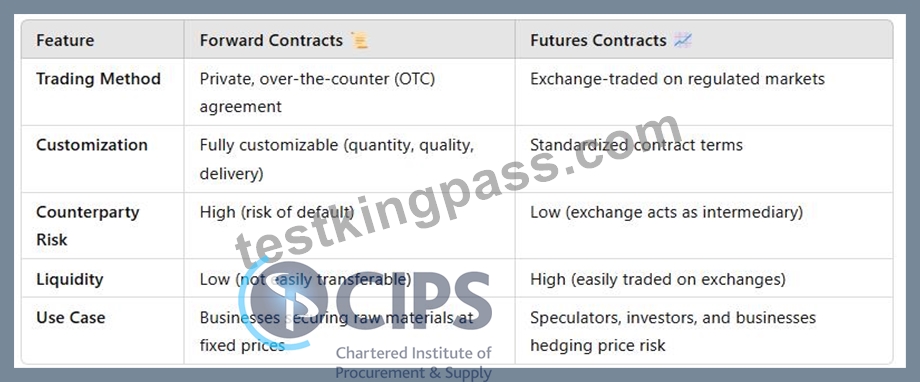
Key Takeaway: Forwards offer flexibility but higher risk, while futures provide standardization and liquidity.
4. Application of Forward and Futures Contracts in the Commodities Market Forwards Used By:
✅ Food manufacturers - Locking in wheat, sugar, or coffee prices for future production.
✅ Oil refineries - Securing crude oil prices to manage fuel costs.
✅ Mining companies - Pre-agreeing on metal prices to secure revenue streams.
Futures Used By:
✅ Airlines - Hedging against fluctuating fuel prices.
✅ Investors - Speculating on gold, oil, or agricultural prices for profit.
✅ Governments - Stabilizing national food or energy reserves.
5. Conclusion
Both forward and futures contracts are essential tools in the commodities market for price risk management.
✅ Forward contracts are customizable but riskier, making them suitable for businesses with specific procurement needs.
✅ Futures contracts offer liquidity and reduced counterparty risk, making them ideal for investors and large corporations managing price volatility.
Organizations must choose the right contract based on their risk tolerance, market exposure, and financial objectives.
NEW QUESTION # 35
SIMULATION
Discuss the role and influence of industry regulators and international bodies in the business environment.
Answer:
Explanation:
The Role and Influence of Industry Regulators and International Bodies in the Business Environment Introduction Industry regulators and international bodies play a critical role in shaping the business environment by enforcing regulations, setting industry standards, and ensuring fair competition. These organizations influence how businesses operate, impacting areas such as trade, finance, environmental sustainability, labor practices, and consumer protection.
Companies must comply with regulations set by both domestic industry regulators and global institutions to maintain legal and ethical business operations.
1. Role of Industry Regulators
Industry regulators are government-appointed or independent organizations that oversee specific sectors to ensure compliance with laws and standards. Their key functions include:
✅ Enforcing Compliance - Ensuring companies adhere to legal requirements (e.g., financial reporting, safety regulations).
✅ Promoting Fair Competition - Preventing monopolies and anti-competitive practices.
✅ Consumer Protection - Safeguarding consumer rights and ensuring product/service quality.
✅ Regulating Market Entry and Operations - Setting standards for licensing, pricing, and ethical conduct.
Example of Industry Regulators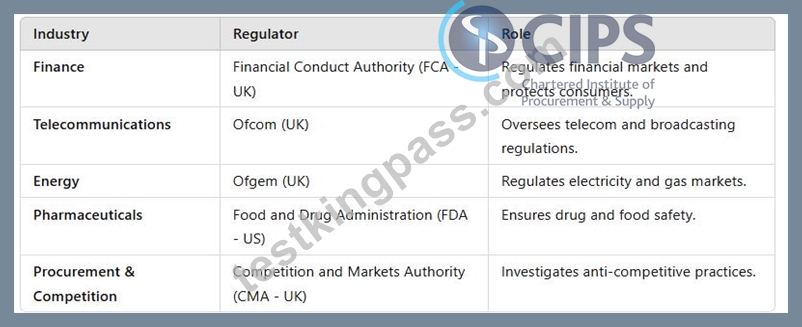
Case Example: The UK's Competition and Markets Authority (CMA) blocked Microsoft's acquisition of Activision Blizzard due to concerns over market dominance in cloud gaming.
2. Role of International Bodies
International bodies set global regulations, trade policies, and ethical standards that influence businesses operating across borders.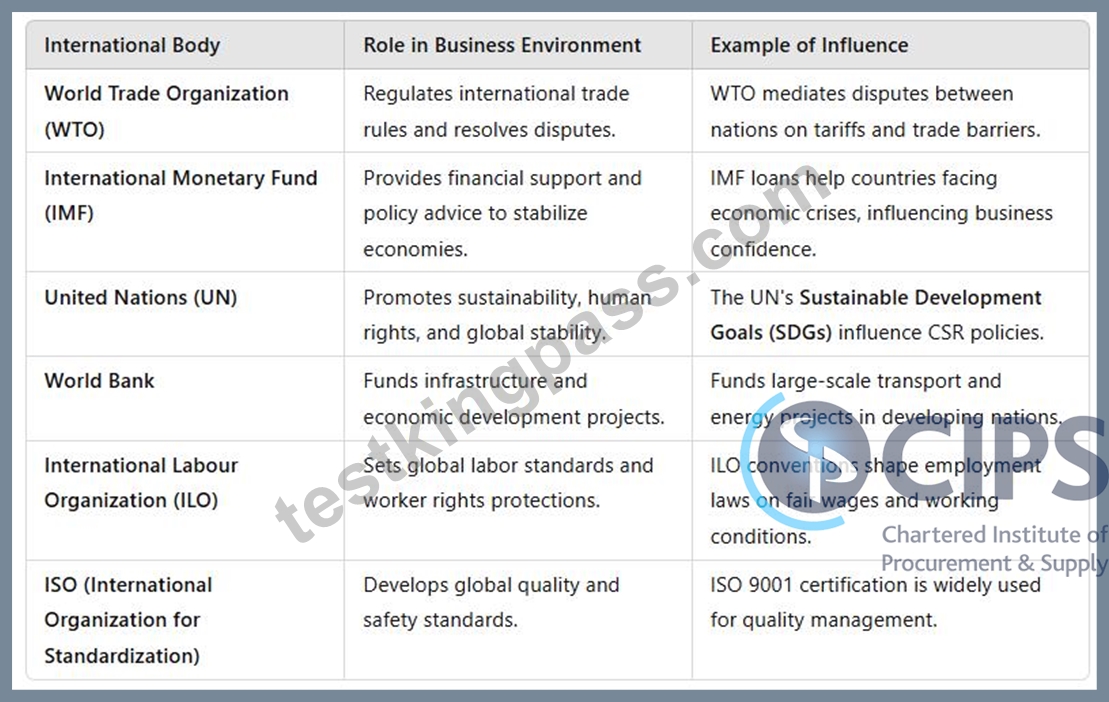
Case Example: The WTO's intervention in Brexit trade negotiations affected tariffs and supply chain costs for UK-based companies.
3. Influence of Industry Regulators and International Bodies on Business Strategy Businesses must align their strategies with regulatory and international frameworks to ensure compliance and avoid financial or reputational risks.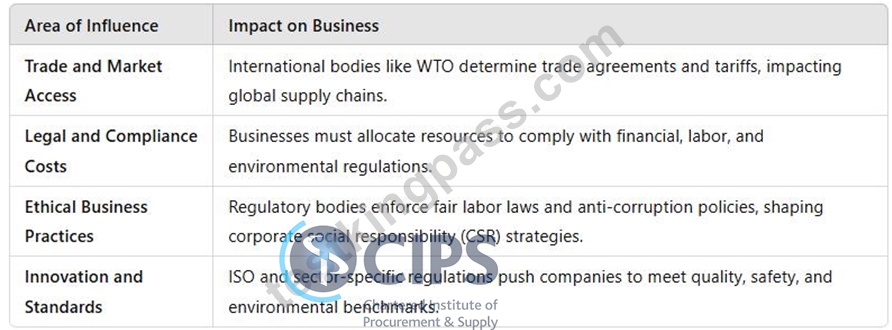
Example: The EU's General Data Protection Regulation (GDPR) forced global companies to enhance data protection policies or face heavy fines.
4. Advantages and Disadvantages of Regulatory and International Influence
✅ Advantages
Promotes Stability & Fair Competition - Reduces market manipulation and corruption.
Protects Consumers & Employees - Ensures safety, fair wages, and ethical standards.
Encourages Innovation & Sustainability - Businesses invest in R&D to meet regulatory requirements.
Facilitates Global Trade - International trade agreements create business opportunities.
❌ Disadvantages
Regulatory Burdens & Compliance Costs - Strict laws increase operational costs.
Trade Barriers & Bureaucracy - Lengthy regulatory approval processes slow down market entry.
Risk of Overregulation - Too many rules can stifle competition and innovation.
Example: The EU Emissions Trading System (EU ETS) requires manufacturers to pay for carbon emissions, increasing operational costs.
Conclusion
Industry regulators and international bodies shape the business environment by enforcing laws, ensuring ethical practices, and facilitating global trade. Companies must proactively monitor regulatory changes, integrate compliance into strategic planning, and adapt to international standards to maintain market competitiveness and sustainability.
NEW QUESTION # 36
SIMULATION
Explain 5 reasons why exchange rates can be volatile
Five Reasons Why Exchange Rates Can Be Volatile
Introduction
Exchange rates are constantly fluctuating due to economic, political, and market forces. Volatility in exchange rates affects global trade, procurement costs, and business profitability. Companies engaged in international supply chains or global expansion must understand the factors that drive currency fluctuations to manage risks effectively.
This answer explores five key reasons why exchange rates experience volatility.
1. Interest Rate Differentials (Monetary Policy Impact)
Explanation:
Central banks set interest rates to control inflation and economic growth. Countries with higher interest rates attract foreign investment, increasing demand for their currency.
✅ How It Causes Volatility?
Rising interest rates → Attracts foreign investors → Currency appreciates Falling interest rates → Reduces investment appeal → Currency depreciates Example: When the US Federal Reserve raises interest rates, the US dollar strengthens as investors move capital to USD-based assets.
Key Takeaway: Exchange rates fluctuate as investors adjust capital flows based on interest rate expectations.
2. Inflation Rates (Purchasing Power Impact)
Explanation:
Inflation reduces the value of money, leading to lower purchasing power. Countries with high inflation tend to see their currency weaken, while those with low inflation maintain a stronger currency.
✅ How It Causes Volatility?
High inflation → Reduces confidence in currency → Depreciation
Low inflation → Increases currency stability → Appreciation
Example: The Turkish Lira has depreciated significantly due to high inflation rates, making imports expensive.
Key Takeaway: Inflation affects the real value of money, influencing exchange rate stability.
3. Speculation and Market Sentiment (Investor Behavior Impact)
Explanation:
Foreign exchange markets (Forex) are driven by investor speculation. Traders buy and sell currencies based on market trends, geopolitical risks, and economic forecasts.
✅ How It Causes Volatility?
If investors expect a currency to strengthen, they buy more → Increases demand and value If investors lose confidence, they sell off holdings → Causes depreciation Example: In 2016, after the Brexit referendum, speculation about the UK economy caused the British pound (GBP) to drop sharply.
Key Takeaway: Investor behavior and speculation create short-term exchange rate volatility.
4. Political Instability & Economic Uncertainty (Government Policies & Geopolitics) Explanation:
Political uncertainty and economic instability weaken investor confidence, leading to capital flight from riskier currencies. Countries with stable governments and strong economies maintain more stable exchange rates.
✅ How It Causes Volatility?
Political crises, elections, or policy changes → Uncertainty → Currency depreciation Stable governance and economic reforms → Confidence → Currency appreciation Example:
Argentina's peso lost value due to economic instability and high debt.
Switzerland's Swiss Franc (CHF) remains strong due to political stability and its reputation as a "safe-haven" currency.
Key Takeaway: Political and economic uncertainty increase exchange rate volatility by influencing investor confidence.
5. Trade Balances & Current Account Deficits 🌎 (Export-Import Impact)
Explanation:
The balance of trade (exports vs. imports) impacts currency demand. Countries that export more than they import experience higher demand for their currency, leading to appreciation. Conversely, nations with large trade deficits see their currencies depreciate.
✅ How It Causes Volatility
Trade surplus (more exports) → Demand for local currency rises → Appreciation Trade deficit (more imports) → Increased need for foreign currency → Depreciation Example:
China's trade surplus strengthens the Chinese Yuan (CNY).
The US dollar fluctuates based on its import-export trade balance.
Key Takeaway: Exchange rates shift as global trade patterns change, affecting currency demand.
Conclusion
Exchange rate volatility is driven by economic, financial, and political factors:
1️⃣ Interest Rates - Higher rates attract investment, strengthening currency.
2️⃣ Inflation Rates - High inflation erodes value, weakening currency.
3️⃣ Speculation & Market Sentiment - Investor behavior influences short-term fluctuations.
4️⃣ Political & Economic Uncertainty - Instability causes capital flight and depreciation.
5️⃣ Trade Balances & Deficits - Export-driven economies see appreciation, while import-heavy nations experience depreciation.
Understanding these drivers helps businesses manage currency risks when engaging in global procurement, contracts, and financial planning.
Answer:
Explanation:
Use of Forward and Futures Contracts in the Commodities Market
Introduction
The commodities market involves the trading of physical goods such as oil, gold, agricultural products, and metals. Due to price volatility, businesses and investors use derivative contracts like forward and futures contracts to manage price risk and ensure stability in supply chains.
Both contracts allow buyers and sellers to agree on a fixed price for a future date, but they differ in terms of standardization, trading methods, and risk exposure.
1. Forward Contracts (Private, Custom Agreements)
Definition
A forward contract is a customized agreement between two parties to buy or sell a commodity at a specified price on a future date. It is a private, over-the-counter (OTC) contract, meaning it is not traded on an exchange.
✅ Key Characteristics:
Customizable terms (quantity, delivery date, price).
Direct agreement between buyer and seller.
Used for hedging against price fluctuations.
Example: A coffee producer agrees to sell 10,000kg of coffee to a distributor in 6 months at a fixed price of $5 per kg, protecting both parties from price swings.
Advantages of Forward Contracts
✔ Tailored to buyer/seller needs - Customizable quantity, quality, and delivery terms.
✔ Reduces price uncertainty - Locks in a price, protecting against market fluctuations.
✔ No upfront cost - No initial margin or collateral required.
Disadvantages of Forward Contracts
❌ High counterparty risk - If one party defaults, the other may face financial losses.
❌ Not regulated or publicly traded - Higher risk of contract disputes.
❌ Limited liquidity - Harder to transfer or sell compared to futures contracts.
Best for: Companies looking for customized price protection in procurement or sales (e.g., food manufacturers, oil refineries).
2. Futures Contracts (Standardized, Exchange-Traded Agreements)
Definition
A futures contract is a standardized agreement to buy or sell a commodity at a predetermined price on a future date. These contracts are traded on organized exchanges (e.g., Chicago Mercantile Exchange (CME), London Metal Exchange (LME)).
✅ Key Characteristics:
Highly regulated and standardized (fixed contract sizes and terms).
Exchange-traded → Increased liquidity and price transparency.
Requires initial margin and daily settlements (mark-to-market system).
Example: A wheat farmer uses futures contracts on the Chicago Board of Trade (CBOT) to lock in wheat prices before harvest, avoiding potential price drops.
Advantages of Futures Contracts
✔ Lower counterparty risk - Exchanges guarantee contract settlement.
✔ High liquidity - Easily bought or sold on futures markets.
✔ Price transparency - Publicly available pricing and standardized contracts.
Disadvantages of Futures Contracts
❌ Less flexibility - Fixed contract sizes and expiration dates.
❌ Margin requirements - Traders must maintain a margin account, requiring cash reserves.
❌ Potential for speculative losses - Prices fluctuate daily, leading to possible margin calls.
Best for: Large-scale buyers/sellers, investors, and companies needing risk management in commodity markets.
3. Key Differences Between Forward and Futures Contracts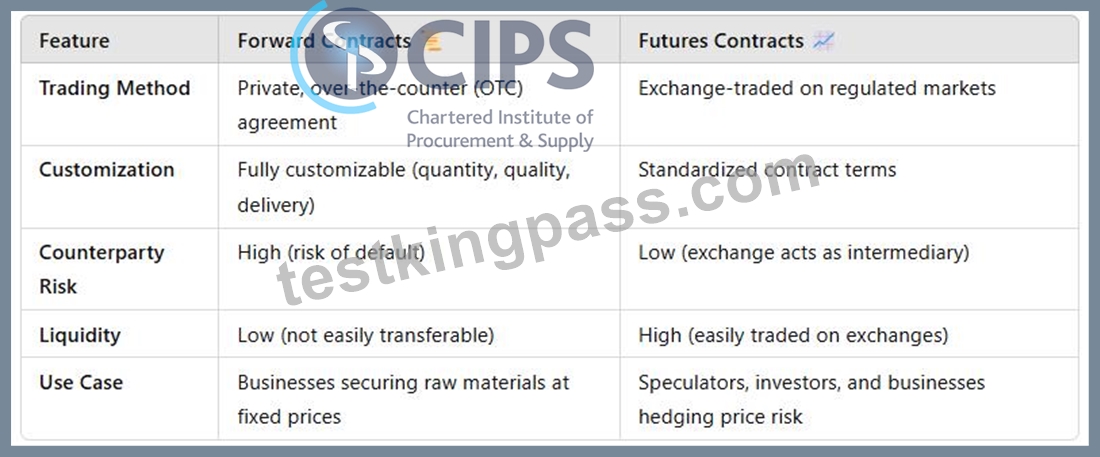
Key Takeaway: Forwards offer flexibility but higher risk, while futures provide standardization and liquidity.
4. Application of Forward and Futures Contracts in the Commodities Market Forwards Used By:
✅ Food manufacturers - Locking in wheat, sugar, or coffee prices for future production.
✅ Oil refineries - Securing crude oil prices to manage fuel costs.
✅ Mining companies - Pre-agreeing on metal prices to secure revenue streams.
Futures Used By:
✅ Airlines - Hedging against fluctuating fuel prices.
✅ Investors - Speculating on gold, oil, or agricultural prices for profit.
✅ Governments - Stabilizing national food or energy reserves.
5. Conclusion
Both forward and futures contracts are essential tools in the commodities market for price risk management.
✅ Forward contracts are customizable but riskier, making them suitable for businesses with specific procurement needs.
✅ Futures contracts offer liquidity and reduced counterparty risk, making them ideal for investors and large corporations managing price volatility.
Organizations must choose the right contract based on their risk tolerance, market exposure, and financial objectives.
NEW QUESTION # 37
SIMULATION
XYZ is a successful cake manufacturer and wishes to expand the business to create additional confectionary items. The expansion will require the purchase of a further manufacturing facility, investment in machinery and the hiring of more staff. The CEO and CFO are confident that the diversification will be a success and are discussing ways to raise funding for the expansion and are debating between dept funding and funding. What are the advantages and disadvantages of each approach?
Answer:
Explanation:
Evaluation of Debt Funding vs. Equity Funding for XYZ's Expansion
Introduction
As XYZ, a successful cake manufacturer, plans to expand into additional confectionery items, it requires significant investment in a new manufacturing facility, machinery, and staff. To finance this expansion, the company must choose between:
Debt Funding - Borrowing from banks or financial institutions.
Equity Funding - Raising capital by selling shares to investors.
Each funding option has advantages and disadvantages that impact financial stability, ownership control, and long-term business strategy.
1. Debt Funding(Loans, Bonds, or Credit Facilities)
Definition
Debt funding involves borrowing money from banks, lenders, or issuing corporate bonds, which must be repaid with interest.
✅ Key Characteristics:
The company retains full ownership and decision-making control.
Loan repayments are fixed and predictable.
Interest payments are tax-deductible.
Example: XYZ takes a bank loan of £2 million to purchase new machinery and repay it over five years with interest.
Advantages of Debt Funding
✔ Ownership Retention - XYZ keeps full control over business decisions.
✔ Predictable Repayment Plan - Fixed monthly payments make financial planning easier.
✔ Tax Benefits - Interest payments reduce taxable income.
✔ Shorter-Term Obligation - Once the loan is repaid, there are no further obligations.
Disadvantages of Debt Funding
❌ Repayment Pressure - Regular repayments increase financial risk during slow sales periods.
❌ Interest Costs - High-interest rates can reduce profitability.
❌ Collateral Requirement - Lenders may require company assets as security.
❌ Credit Risk - If XYZ fails to repay, it risks losing assets or damaging credit ratings.
Best for: Companies that want to maintain ownership and have stable revenue streams to cover repayments.
2. Equity Funding(Selling Shares to Investors or Venture Capitalists)
Definition
Equity funding involves raising capital by selling shares in the company to investors, such as private investors, venture capitalists, or the stock market.
✅ Key Characteristics:
No repayment obligations, but shareholders expect a return on investment (ROI).
Investors gain partial ownership and may influence business decisions.
Funding amount depends on the company's valuation and investor interest.
Example: XYZ sells 20% of its shares to a private investor for £3 million, which funds new production lines.
Advantages of Equity Funding
✔ No Repayment Obligation - Reduces financial burden on cash flow.
✔ Access to Large Capital - Easier to raise significant funds for expansion.
✔ Attracts Strategic Investors - Investors may provide expertise and industry connections.
✔ Spreads Business Risk - Losses are shared with investors, reducing pressure on XYZ.
Disadvantages of Equity Funding
❌ Loss of Ownership & Control - Investors gain a say in company decisions.
❌ Profit Sharing - Dividends or profit-sharing reduce earnings for existing owners.
❌ Longer Decision-Making Process - Raising equity capital takes time due to negotiations and regulatory compliance.
❌ Dilution of Shares - Selling shares reduces the founder's ownership percentage.
Best for: Companies needing large funding amounts with less repayment pressure, but willing to share ownership and decision-making.
3. Comparison: Debt vs. Equity Funding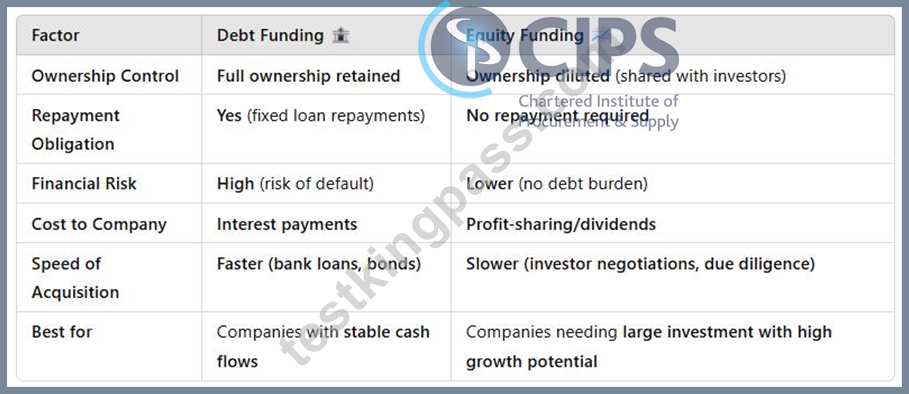
Key Takeaway: The choice between debt and equity funding depends on XYZ's risk tolerance, cash flow stability, and long-term growth strategy.
4. Conclusion & Recommendation
Both debt funding and equity funding offer advantages and risks for XYZ's expansion.
✅ Debt funding is ideal if XYZ wants to retain ownership and has stable revenue to cover loan repayments.
✅ Equity funding is better if XYZ seeks larger investments, strategic expertise, and reduced financial risk.
Recommended Approach: A hybrid strategy, combining debt for short-term capital needs and equity for long-term growth, can provide financial flexibility while minimizing risks.
NEW QUESTION # 38
SIMULATION
Evaluate diversification as a growth strategy. What are the main drivers and risks?
Answer:
Explanation:
Evaluation of Diversification as a Growth Strategy
Introduction
Diversification is a growth strategy where a company expands into new markets or develops new products that are different from its existing offerings. It is the riskiest strategy in Ansoff's Growth Matrix, but it can provide significant opportunities for business expansion, revenue diversification, and risk mitigation.
Diversification is driven by factors such as market saturation, competitive pressure, and technological advancements but also carries risks related to high investment costs and operational complexity.
1. Types of Diversification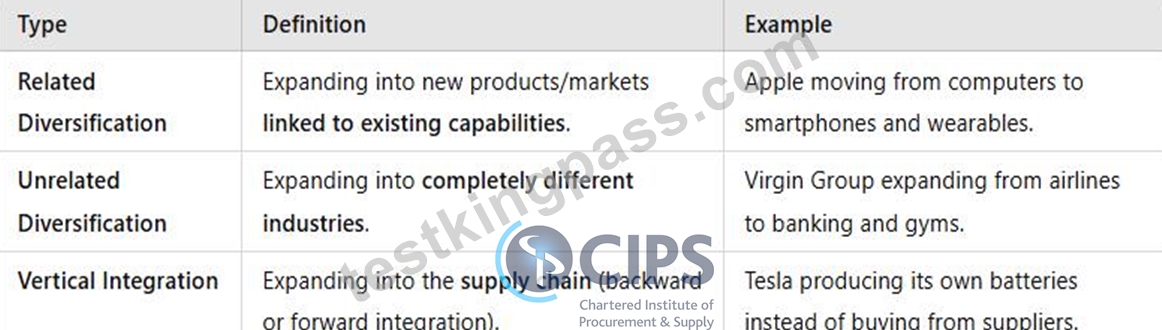
2. Main Drivers of Diversification
1. Market Saturation and Competitive Pressure
When a business reaches peak growth in its existing market, diversification helps find new revenue streams.
Competition forces businesses to explore new industries for continued growth.
Example: Amazon expanded from an online bookstore to cloud computing (AWS) due to competition and limited retail growth.
2. Risk Reduction and Business Sustainability
Diversifying reduces dependence on a single market or product.
Protects the business against economic downturns and industry-specific risks.
Example: Samsung operates in electronics, shipbuilding, and insurance, reducing reliance on one sector.
3. Leveraging Core Competencies and Brand Strength
Companies use existing expertise, technology, or brand reputation to enter new markets.
Example: Nike expanded from sportswear to fitness apps and wearable technology.
4. Technological Advancements & Market Opportunities
Digital transformation and innovation create opportunities for diversification.
Companies invest in new technologies, AI, and automation to expand their offerings.
Example: Google diversified into AI, smart home devices, and autonomous vehicles (Waymo).
3. Risks of Diversification
1. High Investment Costs & Uncertain Returns
Diversification requires significant R&D, marketing, and infrastructure investment.
ROI is uncertain, and failure can result in financial losses.
Example: Coca-Cola's failed diversification into the wine industry resulted in losses due to brand mismatch.
2. Lack of Expertise & Operational Challenges
Expanding into unfamiliar industries increases operational complexity and risks.
Companies may lack the expertise required for success.
Example: Tesco's expansion into the US market (Fresh & Easy) failed due to a lack of understanding of American consumer behavior.
3. Dilution of Brand Identity
Expanding into unrelated sectors can confuse customers and weaken brand strength.
Example: Harley-Davidson's attempt to enter the perfume market damaged its brand credibility.
4. Regulatory and Legal Barriers
Compliance with different industry regulations can be complex and costly.
Example: Facebook faced regulatory scrutiny when diversifying into financial services with Libra cryptocurrency.
4. Conclusion
Diversification can be a high-reward growth strategy, but it requires careful planning, market research, and strategic alignment.
✅ Main drivers include market saturation, risk reduction, leveraging expertise, and technology opportunities.
❌ Key risks include high costs, operational challenges, brand dilution, and regulatory barriers.
Companies must evaluate diversification carefully and ensure strategic fit, financial feasibility, and market demand before expanding into new industries.
NEW QUESTION # 39
......
TestkingPass's L6M2 certification is a dispensable part in IT area. So how can we achieve it in a short time? TestkingPass will be your choice. L6M2 test training materials of TestkingPass are organized by experienced IT experts. If you still worry, you can download L6M2 free demo before purchase.
Valid L6M2 Exam Guide: https://www.testkingpass.com/L6M2-testking-dumps.html
- L6M2 New Learning Materials ⏭ L6M2 Book Free 📻 L6M2 New Learning Materials 🍲 Download ▛ L6M2 ▟ for free by simply searching on ✔ www.itcerttest.com ️✔️ 🧗Reliable L6M2 Exam Labs
- 2025 Pass-Sure CIPS L6M2: Global Commercial Strategy Valid Real Exam 🍕 Simply search for { L6M2 } for free download on ▷ www.pdfvce.com ◁ 😲L6M2 Braindumps Pdf
- Quiz 2025 CIPS L6M2: High Hit-Rate Global Commercial Strategy Valid Real Exam 🙌 ( www.examcollectionpass.com ) is best website to obtain ▷ L6M2 ◁ for free download 🔯Exam L6M2 Demo
- Relevant L6M2 Questions 🐯 Online L6M2 Bootcamps 🍀 Relevant L6M2 Questions 🤚 Easily obtain free download of ➥ L6M2 🡄 by searching on { www.pdfvce.com } ♣L6M2 Practice Exam
- L6M2 – 100% Free Valid Real Exam | High Pass-Rate Valid Global Commercial Strategy Exam Guide 🕐 Search for ⮆ L6M2 ⮄ and obtain a free download on ➠ www.actual4labs.com 🠰 🥘L6M2 Book Free
- L6M2 – 100% Free Valid Real Exam | High Pass-Rate Valid Global Commercial Strategy Exam Guide 🔑 Enter ▷ www.pdfvce.com ◁ and search for ☀ L6M2 ️☀️ to download for free 🚈Exam L6M2 Demo
- New L6M2 Test Sims 🏟 Reliable L6M2 Exam Labs 🌞 Reliable L6M2 Exam Labs 📮 Search for ▛ L6M2 ▟ and download exam materials for free through ☀ www.pass4leader.com ️☀️ 🥶L6M2 Exam Success
- New Release CIPS L6M2 Exam Questions: Right Preparation Method [2025] ❗ Search for ▶ L6M2 ◀ and download it for free immediately on ( www.pdfvce.com ) 🚔Online L6M2 Bootcamps
- CIPS L6M2 Exam | L6M2 Valid Real Exam - Bring you The Best Valid L6M2 Exam Guide 🍤 Open ➽ www.examcollectionpass.com 🢪 and search for 【 L6M2 】 to download exam materials for free 🤬Exam L6M2 Demo
- Here's the Proven and Quick Way to Pass CIPS L6M2 Exam 🎅 Search for ➤ L6M2 ⮘ on 【 www.pdfvce.com 】 immediately to obtain a free download 👇Reliable L6M2 Exam Labs
- L6M2 New Learning Materials 🕢 L6M2 Pass4sure Pass Guide 🐫 Valid L6M2 Test Prep ⚡ Open [ www.torrentvalid.com ] enter [ L6M2 ] and obtain a free download 🪒L6M2 Pdf Braindumps
- L6M2 Exam Questions
- lms.jayakencana.com www.zamtutions.com dvsacademy.com ncertclass.com sam.abijahs.duckdns.org skillup.egvidya.com interncorp.in eishkul.com conceptplusacademy.com getsmartstudy.com