
Ron Martin Ron Martin
0 Course Enrolled • 0 Course CompletedBiography
High Pass-Rate Snowflake ADA-C01 New Dumps Questions offer you accurate Dumps Questions | SnowPro Advanced Administrator
Many people are difficult in getting the ADA-C01 certification successfully. If you also have trouble in passing your exam and getting your certification, we think it is time for you to use our SnowPro Advanced: Administrator quiz prep. If you choose our study materials and use our products well, we can promise that you can pass the exam and get the ADA-C01 Certification. Then you will find you have so many chances to advance in stages to a great level of social influence and success. Our ADA-C01 dumps torrent can also provide all candidates with our free demo, in order to exclude your concerts that you can check our products.
Snowflake ADA-C01 Exam Syllabus Topics:
| Topic | Details |
|---|---|
| Topic 1 |
|
| Topic 2 |
|
| Topic 3 |
|
| Topic 4 |
|
| Topic 5 |
|
| Topic 6 |
|
>> ADA-C01 New Dumps Questions <<
Dumps ADA-C01 Questions | Exam Vce ADA-C01 Free
As long as you follow the steps of our ADA-C01 quiz torrent, your mastery of knowledge will be very comprehensive and you will be very familiar with the knowledge points. This will help you pass the exam more smoothly. The ADA-C01 learning materials are of high quality, mainly reflected in the adoption rate. As for our ADA-C01 exam question, we guaranteed a higher passing rate than that of other agency. More importantly, we will promptly update our ADA-C01 Quiz torrent based on the progress of the letter and send it to you. 99% of people who use our ADA-C01 quiz torrent has passed the exam and successfully obtained their certificates, which undoubtedly show that the passing rate of our ADA-C01 exam question is 99%. So our product is a good choice for you. Choose our ADA-C01 learning materials, you will gain a lot and lay a solid foundation for success.
Snowflake SnowPro Advanced Administrator Sample Questions (Q38-Q43):
NEW QUESTION # 38
When adding secure views to a share in Snowflake, which function is needed to authorize users from another account to access rows in a base table?
- A. CURRENT_ROLE
- B. CURRENT_CLIENT
- C. CURRENT ACCOUNT
- D. CURRENT_USER
Answer: D
Explanation:
Explanation
According to the Working with Secure Views documentation, secure views are designed to limit access to sensitive data that should not be exposed to all users of the underlying table(s). When sharing secure views with another account, the view definition must include a function that returns the identity of the user who is querying the view, such as CURRENT_USER, CURRENT_ROLE, or CURRENT_ACCOUNT. These functions can be used to filter the rows in the base table based on the user's identity. For example, a secure view can use the CURRENT_USER function to compare the user name with a column in the base table that contains the authorized user names. Only the rows that match the user name will be returned by the view. The CURRENT_CLIENT function is not suitable for this purpose, because it returns the IP address of the client that is connected to Snowflake, which is not related to the user's identity.
NEW QUESTION # 39
A company has many users in the role ANALYST who routinely query Snowflake through a reporting tool.
The Administrator has noticed that the ANALYST users keep two
small clusters busy all of the time, and occasionally they need three or four clusters of that size.
Based on this scenario, how should the Administrator set up a virtual warehouse to MOST efficiently support this group of users?
- A. Create a standard X-Large warehouse, which is equivalent to four small clusters. Set the warehouse to auto-resume and auto-suspend, and give USAGE privileges to the ANALYST role.
- B. Create four virtual warehouses (sized Small through XL) and set them to auto-suspend andauto-resume.
Have users in the ANALYST role select the appropriate warehouse based on how many queries are being run. - C. Create a multi-cluster warehouse with MIN_CLUSTERS set to 1. Give MANAGE privileges to the ANALYST role so this group can start and stop the warehouse, and increase the number of clusters as needed.
- D. Create a multi-cluster warehouse with MIN_CLUSTERS set to 2. Set the warehouse to auto-resume and auto-suspend, and give USAGE privileges to the ANALYST role. Allow the warehouse to auto-scale.
Answer: D
Explanation:
Explanation
According to the Snowflake documentation1, a multi-cluster warehouse is a virtual warehouse that consists of multiple clusters of compute resources that can scale up or down automatically to handle the concurrency and performance needs of the queries submitted to the warehouse. A multi-cluster warehouse has a minimum and maximum number of clusters that can be specified by the administrator. Option B is the most efficient way to support the group of users, as it allows the administrator to create a multi-cluster warehouse with MIN_CLUSTERS set to 2, which means that the warehouse will always have two clusters running to handle the standard workload. The warehouse can also auto-scale up to the maximum number of clusters (which can be set according to the peak workload) when there is a spike in demand, and then scale down when the demand decreases. The warehouse can also auto-resume and auto-suspend, which means that the warehouse will automatically start when a query is submitted and automatically stop after a period of inactivity. The administrator can also give USAGE privileges to the ANALYST role, which means that the users can use the warehouse to execute queries and load data, but not modify or operate the warehouse. Option A is not efficient, as it requires the users to manually start and stop the warehouse, and increase the number of clusters as needed, which can be time-consuming and error-prone. Option C is not efficient, as it creates a standard X-Large warehouse, which is equivalent to four small clusters, which may be more than needed for the standard workload, and may not be enough for the peak workload. Option D is not efficient, as it creates four virtual warehouses of different sizes, which can be confusing and cumbersome for the users to select the appropriate warehouse based on how many queries are being run, and may also result in wasted resources and costs.
NEW QUESTION # 40
A Snowflake customer is experiencing higher costs than anticipated while migrating their data warehouse workloads from on-premises to Snowflake. The migration workloads have been deployed on a single warehouse and are characterized by a large number of small INSERTs rather than bulk loading of large extracts. That single warehouse has been configured as a single cluster, 2XL because there are many parallel INSERTs that are scheduled during nightly loads.
How can the Administrator reduce the costs, while minimizing the overall load times, for migrating data warehouse history?
- A. There should be another 2XL warehouse deployed to handle a portion of the load queries.
- B. The warehouse should be kept as a SMALL or XSMALL and configured as a multi-cluster warehouse to handle the parallel load queries.
- C. The 2XL warehouse should be changed to 4XL to increase the number of threads available for parallel load queries.
- D. The INSERTS should be converted to several tables to avoid contention on large tables that slows down query processing.
Answer: B
Explanation:
Explanation
According to the Snowflake Warehouse Cost Optimization blog post, one of the strategies to reduce the cost of running a warehouse is to use a multi-cluster warehouse with auto-scaling enabled. This allows the warehouse to automatically adjust the number of clusters based on the concurrency demand and the queue size. A multi-cluster warehouse can also be configured with a minimum and maximum number of clusters, as well as a scaling policy to control the scaling behavior. This way,the warehouse can handle the parallel load queries efficiently without wasting resources or credits. The blog post also suggests using a smaller warehouse size, such as SMALL or XSMALL, for loading data, as it can perform better than a larger warehouse size for small INSERTs. Therefore, the best option to reduce the costs while minimizing the overall load times for migrating data warehouse history is to keep the warehouse as a SMALL or XSMALL and configure it as a multi-cluster warehouse to handle the parallel load queries. The other options are incorrect because:
*A. Deploying another 2XL warehouse to handle a portion of the load queries will not reduce the costs, but increase them. It will also introduce complexity and potential inconsistency in managing the data loading process across multiple warehouses.
*B. Changing the 2XL warehouse to 4XL will not reduce the costs, but increase them. It will also provide more compute resources than needed for small INSERTs, which are not CPU-intensive but I/O-intensive.
*D. Converting the INSERTs to several tables will not reduce the costs, but increase them. It will also create unnecessary data duplication and fragmentation, which will affect the query performance and data quality.
NEW QUESTION # 41
An Administrator has a warehouse which is intended to have a credit quota set for 3000 for each calendar year.
The Administrator needs to create a resource monitor that
will perform the following tasks:
1. At 80% usage notify the account Administrators.
2. At 100% usage suspend the warehouse and notify the account Administrators.
3. At 120% stop all running executions, suspend the warehouse, and notify the account Administrators.
Which SQL command will meet these requirements?
- A. create or replace resource monitor RM1 with credit_quota=3000
frequency = yearly
start_timestamp = '2022-01-01 00:00 CET'
triggers on 80 percent do notify
on 100 percent do suspend
on 120 percent do suspend_immediate;
alter warehouse WH1 set resource monitor = RM1; - B. create or replace resource monitor RM1 with credit_quota=3000
start_timestamp = '2022-01-01 00:00 CET'
triggers on 80 percent do notify
on 100 percent do notify and suspend
on 120 percent do notify and suspend_immediate;
alter warehouse WH1 set resource monitor = RM1; - C. create or replace resource monitor RM1 with credit_quota=3000
start_timestamp = '2022-01-01 00:00 CET'
triggers on 80 percent do notify
on 100 percent do suspend
on 120 percent do suspend_immediate;
alter warehouse WH1 set resource_monitor = RM1; - D. create or replace resource monitor RM1 with credit_quota=3000
frequency = yearly
triggers on 80 percent do notify
on 100 percent do suspend
on 120 percent do suspend_immediate;
alter warehouse WH1 set resource_monitor = RM1;
Answer: A
Explanation:
Explanation
Option B is the correct SQL command to create a resource monitor that meets the requirements. It sets the credit quota to 3000, the frequency to yearly, the start timestamp to January 1, 2022, and the triggers to notify and suspend the warehouse at the specified thresholds. Option A is incorrect because it does not specify the frequency. Option C is incorrect because it does not specify the frequency and it uses notify and suspend instead of suspend and suspend_immediate. Option D is incorrect because it does not specify the start timestamp. For more information about resource monitors, see Working with Resource Monitors and CREATE RESOURCE MONITOR.
NEW QUESTION # 42
Review the output of the SHOW statement below which displays the current grants on the table DB1. S1. T1: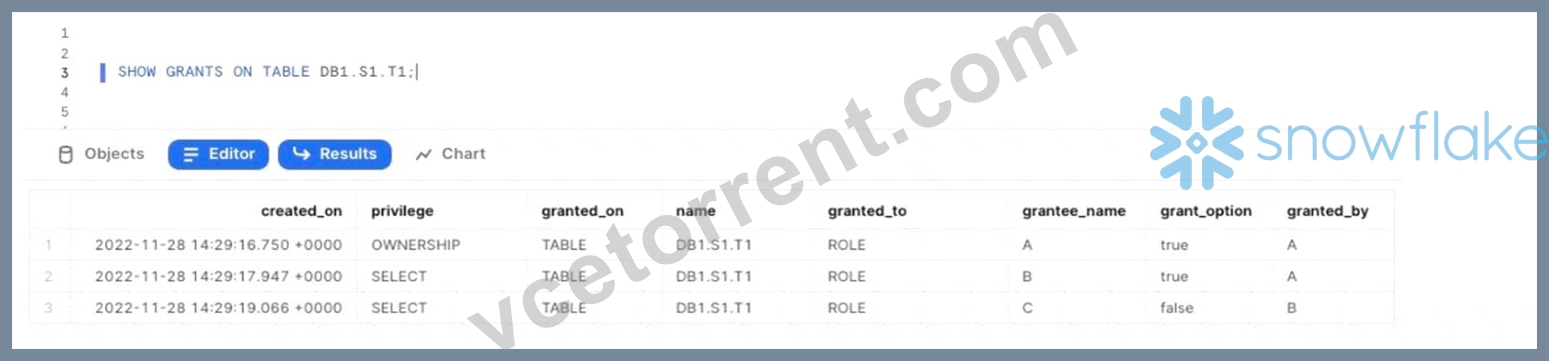
This statement is executed:
USE ROLE ACCOUNTADMIN;
DROP ROLE A;
What will occur?
- A. The SELECT privileges for roles B and C will remain.
- B. The table object DB1. S1. T1 will be dropped.
- C. The OWNERSHIP privilege on table DB1. S1. T1 will be transferred to the ACCOUNTADMIN role.
- D. The SELECT privilege on table DB1. S1. T1 to role B will be shown as GRANTED_BY the role ACCOUNTADMIN.
Answer: A
Explanation:
Explanation
Dropping role A does not affect the SELECT privileges granted to roles B and C on the table DB1.S1.T1.
According to the Snowflake documentation, dropping a role revokes all privileges granted to the role, but does not revoke any privileges granted by the role. Therefore, the OWNERSHIP privilege on the table DB1.S1.T1 will be revoked from role A, but the SELECT privileges granted by role A to role B and by role B to role C will remain. The GRANTED_BY column will still show the original grantor of the privilege, not the ACCOUNTADMIN role.
NEW QUESTION # 43
......
Customers of VCETorrent will also receive updates for 1 year after purchase. A lot of students have prepared from the for the SnowPro Advanced Administrator (ADA-C01) certification test and passed it in a single try. They have rated the SnowPro Advanced Administrator (ADA-C01) as one of the best in the market to prepare for the ADA-C01 exam it in minimum time. Try a free demo now and start your journey towards your dream certification!
Dumps ADA-C01 Questions: https://www.vcetorrent.com/ADA-C01-valid-vce-torrent.html
- Training ADA-C01 Materials 🌗 Reliable ADA-C01 Test Braindumps 🖕 Sample ADA-C01 Exam 👽 Open ➠ www.passcollection.com 🠰 and search for ⮆ ADA-C01 ⮄ to download exam materials for free 🥕ADA-C01 Latest Exam Online
- Test ADA-C01 Questions Vce 👹 ADA-C01 Latest Exam Dumps 🤿 Reliable ADA-C01 Test Braindumps ↕ Immediately open ➽ www.pdfvce.com 🢪 and search for ▶ ADA-C01 ◀ to obtain a free download 🧍ADA-C01 Practice Exam Fee
- Free PDF Quiz 2025 Latest Snowflake ADA-C01: SnowPro Advanced Administrator New Dumps Questions 🐵 Search on [ www.pass4leader.com ] for { ADA-C01 } to obtain exam materials for free download 📏ADA-C01 Reliable Braindumps Files
- ADA-C01 Study Group ❔ Sample ADA-C01 Exam 🌈 Test ADA-C01 Questions Vce 🖖 Open ➠ www.pdfvce.com 🠰 enter 【 ADA-C01 】 and obtain a free download 🧈Sample ADA-C01 Exam
- Pass Guaranteed 2025 High-quality ADA-C01: SnowPro Advanced Administrator New Dumps Questions 📺 Download 「 ADA-C01 」 for free by simply searching on ➠ www.examcollectionpass.com 🠰 🌆Test ADA-C01 Questions Vce
- ADA-C01 New Dumps Questions Exam 100% Pass | Snowflake ADA-C01: SnowPro Advanced Administrator 🐇 Easily obtain ▶ ADA-C01 ◀ for free download through “ www.pdfvce.com ” 🏥ADA-C01 Sample Questions Pdf
- Online ADA-C01 Bootcamps 🗼 ADA-C01 Lab Questions 😁 Training ADA-C01 Materials 🦟 Go to website 「 www.lead1pass.com 」 open and search for ➠ ADA-C01 🠰 to download for free 🧐ADA-C01 Study Group
- ADA-C01 Testdump 👦 Online ADA-C01 Bootcamps 🔻 Sample ADA-C01 Exam 👼 Enter ▶ www.pdfvce.com ◀ and search for ▷ ADA-C01 ◁ to download for free 🍑Test ADA-C01 Dump
- Pass Guaranteed Snowflake - Fantastic ADA-C01 - SnowPro Advanced Administrator New Dumps Questions 👮 Search for ➡ ADA-C01 ️⬅️ and download it for free on ➡ www.itcerttest.com ️⬅️ website 🎸ADA-C01 Latest Exam Dumps
- Pass Guaranteed 2025 High-quality ADA-C01: SnowPro Advanced Administrator New Dumps Questions ⬛ Easily obtain free download of ( ADA-C01 ) by searching on ▛ www.pdfvce.com ▟ 🔌VCE ADA-C01 Exam Simulator
- ADA-C01 Lab Questions 🎺 ADA-C01 Reliable Braindumps Files 🍕 ADA-C01 Practice Exam Fee 🥮 Search for 【 ADA-C01 】 on ▶ www.pdfdumps.com ◀ immediately to obtain a free download 💾ADA-C01 Testdump
- ADA-C01 Exam Questions
- evanree836.blog-kids.com leereed397.nizarblog.com sudacad.net saintraphaelcareerinstitute.net soocareer.com onlyofficer.com programi.healthandmore.rs niloyitinstitute.com supartwi.com moneyshiftcourses.com